
It Is 4:30 PM on Ngong Road. The Bus Is Not Here Yet.
Picture this. A mother in Karen checks her phone for the tenth time. Her daughter's school bus should have arrived forty minutes ago. She calls the school. The receptionist puts her on hold. The transport manager checks a WhatsApp group. Nobody knows exactly where the bus is or why it is late.
Her mind goes to Ngong Road. The potholes near Bomas. The matatus cutting lanes near Karen roundabout. The news headline she saw last month.
This scene plays out at schools across Nairobi every single week. It is not a rare overreaction. It is the predictable result of running student transport without real-time visibility. And for school principals and transport managers, it is both a reputational risk and a legal liability.
The good news: this problem is completely solvable. GPS school bus tracking in Nairobi is no longer a luxury reserved for elite international schools. It is now the standard that informed parents expect, and that responsible schools are adopting fast.
The Nairobi School Transport Safety Problem
Nairobi's roads are unforgiving. School buses navigate Lang'ata Road, Waiyaki Way, Thika Superhighway, and the Eastern Bypass daily. These are some of Kenya's highest-risk corridors for road incidents, congestion, and unpredictable driver behaviour.
The risks facing school transport operations in Nairobi include:
- Heavy traffic that delays buses with no way to communicate live ETAs to parents
- Drivers taking unauthorised routes or stops
- Speeding on open stretches like the Southern Bypass
- Buses operating with no panic button or emergency escalation system
- Schools unable to prove due diligence when incidents occur
- Zero visibility for parents between drop-off and pick-up
When an incident happens and a school cannot produce a trip record, a speed log, or a route history, the consequences are severe. Parents escalate. Boards investigate. Reputations suffer. In worst-case scenarios, legal exposure follows.
The question is no longer whether Nairobi schools need a GPS tracking solution. The question is which solution is built specifically for the job.
What Nairobi Parents Are Demanding From Schools Today
The expectations of Nairobi parents, particularly in private and mid-tier schools, have shifted dramatically in the last three years. The pandemic normalised real-time digital communication. Parents now expect the same transparency from school transport that they get from Uber or Glovo.
Specifically, parents are asking their schools for:
- Live location access. They want to open an app and see the bus on a map, right now.
- Arrival alerts. A push notification when the bus is ten minutes away so they can step outside or send the househelp downstairs.
- Pick-up confirmation. Proof that their child boarded the bus and was dropped at the correct stop.
- Incident notifications. An immediate alert if the bus is delayed, rerouted, or involved in an emergency.
- Driver accountability. The knowledge that drivers are being monitored and are behaving responsibly.
Schools that cannot offer this are already losing enrolment conversations to those that can. Transport safety has become a school-choice factor, not just an operational consideration.
How Venus School Bus Hub Works
The Venus School Bus Hub is built specifically for school transport operations. It is not a generic fleet tracker retrofitted for schools. Every feature is designed around the student transport use case.
Real-Time GPS Tracking
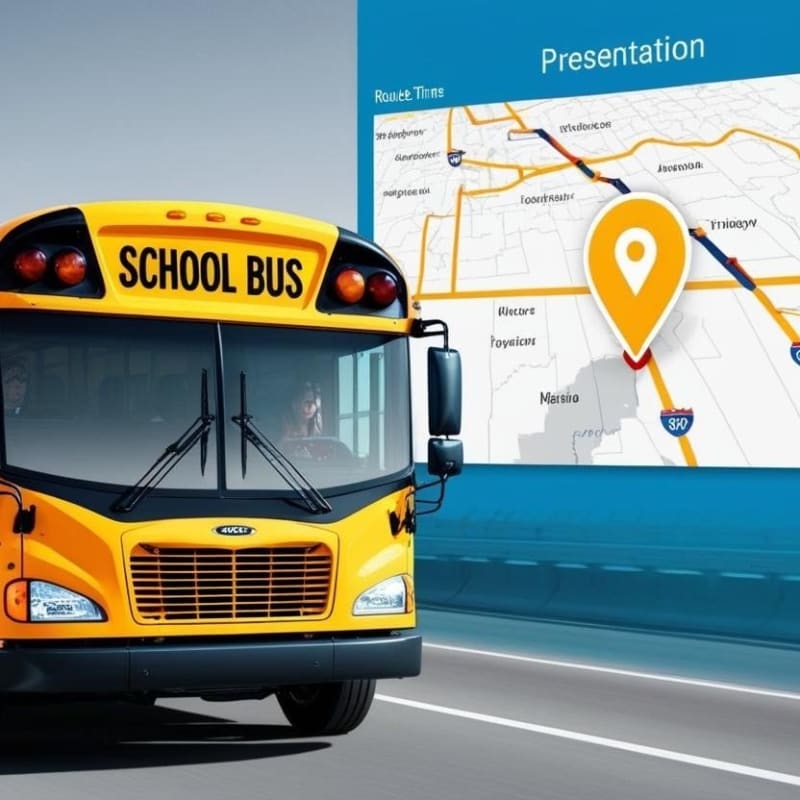
Every bus is tracked live on the Venus Platform. School transport managers see all vehicles on a single dashboard. Position updates are near-instant. Route history is stored and searchable. There are no blind spots.
Parent Notifications App
Parents receive a dedicated mobile app linked to their child's assigned bus. The app shows live bus location on a map. It sends automated push alerts when the bus departs the school, when it is approaching the pick-up stop, and when the child has been dropped off. Parents stop calling the school. They check the app.
Geofence Alerts
Transport managers draw digital boundaries around the school, each bus stop, and any restricted zones. The moment a bus crosses a boundary, the system triggers an automatic alert. If a bus enters an area it should not be in, the school knows immediately, not twenty minutes later.
Driver Behaviour Monitoring
Speed violations, harsh braking, rapid acceleration, and long idling events are all logged automatically. Transport managers receive daily driver scorecards. Repeat offenders are flagged before they become a risk. Schools can enforce standards with data, not guesswork.
Panic Button and Emergency Escalation
Buses are fitted with a physical panic button. In any emergency, the driver or a chaperone presses it and the system immediately alerts the school's transport manager and designated emergency contacts. Response time drops from minutes to seconds.
Trip Reports and Compliance Records
Every trip is logged: departure time, route taken, stops made, speed profile, arrival time. Schools have a complete digital record for every journey. In the event of a complaint or incident, the data is there.
A Real Walkthrough: A Nairobi Private School With 8 Buses and 300 Students
Consider a mid-sized private school in Westlands running eight school buses across routes covering Lavington, Kilimani, Spring Valley, Runda, and Kasarani. Before installing Venus School Bus Hub, the transport manager was managing everything via phone calls and driver WhatsApp messages. Delays caused panicked parents flooding the school's switchboard every afternoon.
Week One After Installation
All eight buses were fitted with GPS-enabled trackers. Drivers received brief onboarding training. Parents were onboarded onto the app in batches via a school circular. Within four days, parent inbound calls to the school's transport line dropped by over 70 percent.
Month One Results
- Three drivers flagged for speeding on Waiyaki Way. All three were counselled and speed violations dropped the following week.
- One bus took an unauthorised detour near Westgate. The geofence alert fired within ninety seconds. The driver was contacted immediately.
- Parents rated school communication around transport significantly higher in that month's satisfaction survey.
- The school's board received a transport compliance report for the first time in its history.
Term-End Summary
The principal presented the term's full trip data to the school board. Zero unreported incidents. Full route compliance. Driver behaviour scores trending upward. The school renewed its subscription and extended the system to cover two additional service vans.
This is not a hypothetical. This is what structured, purpose-built school bus tracking delivers in a Nairobi context.
Frequently Asked Questions
Is GPS school bus tracking expensive for Kenyan schools?
The cost of GPS tracking is significantly lower than the cost of one serious incident. Trackalways Africa offers flexible packages for schools based on fleet size. Contact our team at trackalwaysafrica.com/contact or call +254 116 257285 for a customised quote.
How do parents access the tracking app?
Parents download the Venus parent app and are linked to their child's assigned bus. The school controls which parents have access. Setup takes minutes per student.
What happens if a bus loses network signal?
The tracker stores data locally and syncs as soon as connectivity is restored. The system also flags signal loss events so the transport manager is aware in real time.
Can the system track multiple buses at once?
Yes. The Venus Platform displays all buses on a single dashboard simultaneously. There is no limit based on fleet size.
Does it work on Nairobi's roads, including areas with patchy network?
Yes. Our trackers are optimised for Kenyan network conditions, including areas with variable coverage. The hardware is field-tested across East African roads.
How long does installation take?
A standard school bus GPS installation takes under two hours per vehicle. For a fleet of eight buses, full installation is typically completed within one day.
Is this only for large schools?
No. Schools with as few as two buses can benefit from Venus School Bus Hub. The system scales up or down based on your operation.
The Standard Has Changed. Your School Should Too.
Nairobi parents are no longer willing to accept silence when their child is on a school bus. They have smartphones. They expect real-time information. Schools that provide it build trust and earn loyalty. Schools that do not are falling behind, and they know it.
Trackalways Africa has built a solution specifically for this environment. Venus School Bus Hub is GPS school bus tracking designed for Kenyan roads, Kenyan schools, and Kenyan parents.
If your school operates buses and does not yet have a real-time tracking system in place, the conversation is overdue. Your parents deserve better than a busy phone line. Your students deserve a school that takes transport safety seriously.
Explore our full School Bus Management solution or reach out directly. Call us on +254 116 257285 or visit trackalwaysafrica.com/contact to book a free demo for your school.