
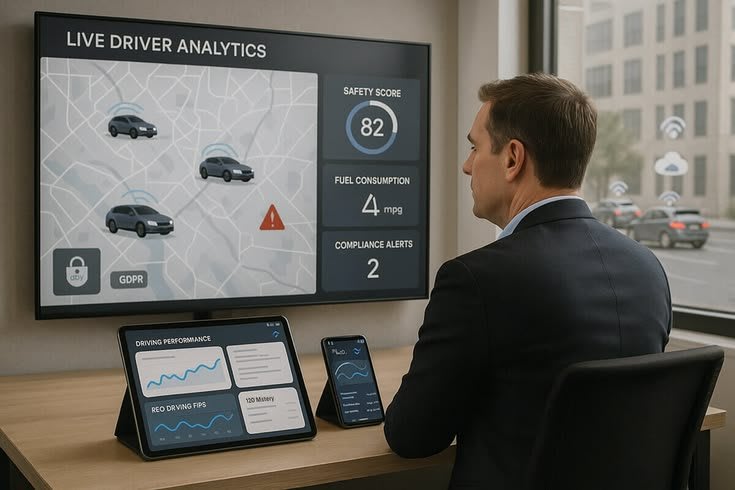
A fleet manager cannot be in every vehicle at the same time.
That is the fundamental challenge of driver management.
A company may have ten vehicles, fifty vehicles or several hundred vehicles operating across Nairobi, Mombasa, Kisumu, Eldoret and cross-border routes. Supervisors cannot physically observe every journey.
Yet driving behaviour directly affects safety, fuel consumption, vehicle wear and customer experience.
This is why modern fleet management is moving beyond simply asking:
“Where is the vehicle?”
The better question is:
“How is the vehicle being driven?”
What Is Driver Behaviour Monitoring?
Driver behaviour monitoring uses telematics data to identify driving events and patterns.
Depending on the hardware and configuration, a fleet management system can monitor events such as:
Speeding
Harsh braking
Rapid acceleration
Sharp cornering
Excessive idling
Driving outside approved conditions
Distracted driving when supported by AI video
Fatigue indicators when supported by driver monitoring technology
The objective should not be to create a system that simply punishes drivers.
The real value is creating measurable information that can support coaching, accountability and safer driving.
Why Driver Behaviour Matters
Unsafe driving creates more than accident risk.
Aggressive acceleration and braking can contribute to higher fuel consumption and vehicle wear. Excessive speeding increases risk. Unnecessary idling wastes fuel. Repeated harsh events may indicate that a driver needs additional coaching.
The World Health Organization identifies speeding and distracted driving among major road-safety concerns, and reports that drivers using mobile phones are approximately four times more likely to be involved in a crash than drivers who are not using a phone.
For commercial fleets, the implication is straightforward:
Driver behaviour deserves to be measured, not assumed.
GPS Tracking Is Only the Starting Point
Traditional GPS tracking answers basic operational questions:
Where is the vehicle?
Where has it been?
How fast is it moving?
What route did it take?
That information is valuable.
But advanced telematics can add another layer.
The system can associate driving events with individual vehicles and, when driver identification is enabled, individual drivers.
This creates a much clearer picture of fleet performance.
From Driver Data to Driver Coaching
Data becomes useful when it changes behaviour.
Suppose a fleet manager notices that one driver repeatedly records harsh braking events.
The first response should not necessarily be disciplinary action.
The manager can investigate:
Where are the events happening?
Are they concentrated around a particular route?
Is traffic contributing?
Are road conditions a factor?
Is the behaviour consistent across multiple journeys?
Does video evidence provide additional context?
Does the driver need coaching?
This turns telematics from a surveillance tool into a management tool.
Why Video Telematics Adds Another Layer
GPS data can tell you that harsh braking occurred.
Video can help explain why.
TrackAlways Africa's video telematics solution combines live video, AI incident detection, driver behaviour analysis, safety alerts and driver scorecards.
With compatible AI dashcams, fleet managers can investigate events involving:
Driver distraction
Fatigue
Harsh driving
Road incidents
Unsafe driving behaviour
Collision events
This distinction matters.
A GPS event might tell a manager what happened.
Video may help show what was happening around the event.
Building a Driver Scorecard
A useful driver scorecard should not simply rank drivers from best to worst.
It should identify trends.
For example:
| Metric | What it can show |
|---|---|
| Speeding | Compliance with speed thresholds |
| Harsh braking | Aggressive or defensive driving patterns |
| Acceleration | Driving smoothness |
| Cornering | Risky manoeuvres |
| Idling | Avoidable engine-on time |
| Incidents | Safety events requiring investigation |
| Fatigue/distraction | AI video safety indicators where supported |
Fleet managers can then identify drivers who consistently perform well and drivers who require targeted coaching.
Use Data to Reward Good Drivers Too
Driver monitoring should not be built entirely around punishment.
If one driver consistently records:
Low speeding events
Low harsh braking
Low idling
Strong route compliance
Few safety incidents
that driver is demonstrating measurable performance.
The business can use the information to recognise good performance, support incentive programmes or identify best-practice driving behaviors that can be shared with the wider team.
How Driver Monitoring Can Support Fuel Efficiency
Driver behavior and fuel management are closely connected.
Unnecessary acceleration, excessive idling and inefficient driving can increase fuel consumption.
That is why driver data becomes even more valuable when combined with fuel monitoring.
TrackAlways Africa's fuel monitoring solution provides real-time fuel data, consumption analytics and theft alerts, with compatible sensor integrations into the fleet platform.
This creates a stronger operational picture:
Driver behavior + vehicle movement + fuel data = better fleet accountability.
How to Introduce Driver Monitoring Without Creating Resistance
Technology alone does not create safer drivers.
Communication matters.
Before deployment, companies should explain:
Why monitoring is being introduced
What information will be collected
Who can access the information
How driver scores will be used
How incidents will be investigated
How good performance will be recognised
Fleet operators should also consider Kenya's data protection requirements when collecting and processing employee-related information.
The Office of the Data Protection Commissioner identifies location data as personal data and provides the regulatory framework under Kenya's Data Protection Act, 2019.
What Should Kenyan Fleet Managers Look For?
A strong driver-monitoring solution should offer:
Real-time tracking: Know where the vehicle is.
Event detection. Identify significant driving events.
Driver identification. Connect activity to the correct driver where appropriate.
Scorecards. Turn individual events into understandable performance indicators.
Video integration. Provide context for significant incidents.
Alerts: Surface important events quickly.
Reporting. Track improvement over time.
Frequently Asked Questions
What is driver behaviour monitoring?
Driver behaviour monitoring uses telematics data to measure driving patterns such as speeding, harsh braking, acceleration, cornering and idling.
Can GPS tracking identify bad driving?
GPS tracking can identify some driving events, such as speeding, harsh braking and route deviations. More advanced systems can add driver identification and AI video analysis.
Can AI dashcams monitor driver behaviour?
Yes. Compatible AI dashcams can detect specific safety events such as distraction and fatigue, depending on the camera's capabilities and configuration.
Should driver monitoring be used to punish drivers?
Not necessarily. The strongest approach uses the data for coaching, accountability, recognition and safety improvement, with clear policies governing how monitoring information is used.
Final Takeaway
A fleet manager cannot improve what the business cannot measure.
Driver behaviour monitoring gives Kenyan fleet operators a practical way to move from assumptions to evidence.
When GPS tracking, driver identification, AI video and fuel data work together, managers gain a much clearer picture of what happens on the road.
The goal is not simply to watch drivers.
It is to help drivers operate more safely, consistently and efficiently.